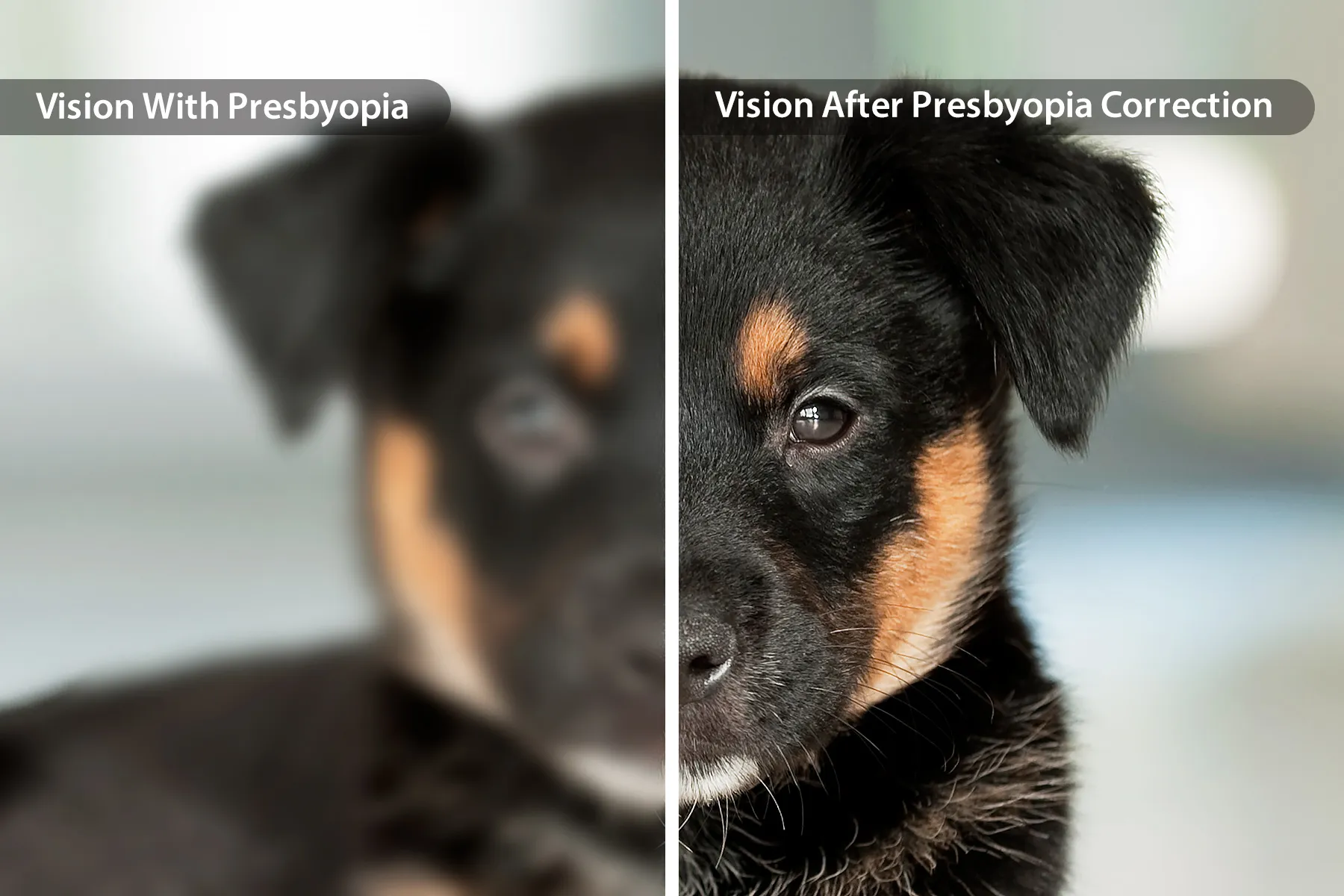
Have you started holding your phone a little farther away to read a text? Maybe restaurant menus seem harder to see in dim lighting, or small print that used to be clear suddenly feels like work.
If you’re in your 40s or beyond, these changes may be caused by presbyopia, a normal age-related change in the way your eyes focus up close. Presbyopia becomes increasingly common with age and often starts becoming noticeable in the 40s.
The good news is that blurry near vision doesn’t mean you simply have to live with it. An eye exam can determine what’s causing the change and help you find a vision correction option that fits your daily life.
Presbyopia is an age-related refractive condition that makes it more difficult to focus clearly on nearby objects.
When you’re younger, the natural lens inside your eye is flexible enough to change shape as you switch your focus between something far away and something close to you. As you get older, that lens gradually becomes harder and less flexible. This reduces your ability to focus at close distances.
That’s why reading a text message, checking a price tag, working on a laptop, or looking at a restaurant menu can suddenly require more effort than it used to.
Presbyopia is also different from farsightedness, or hyperopia. While both can make close-up vision difficult, they have different underlying causes.
Presbyopia usually develops gradually, so you may adjust your habits without immediately realizing your vision has changed.
Common signs can include:
These symptoms are common with presbyopia, but not every change in vision should automatically be attributed to age. A comprehensive eye exam can evaluate your prescription as well as your overall eye health and determine what is actually affecting your vision.

Presbyopia is part of the eye’s natural aging process.
As the lens becomes less flexible, your eyes lose some of their ability to adjust focus for nearby objects. The change typically happens gradually rather than overnight, which is why you may first notice it during tasks involving particularly small print or low lighting.
Your existing prescription can also affect how you experience presbyopia. Someone who already wears glasses for nearsightedness, farsightedness, or astigmatism may notice the change differently than someone who has never needed corrective lenses before.
That’s one reason an eye exam is important. Instead of guessing which pair of reading glasses to buy, your eye doctor can evaluate how your eyes are focusing at different distances and recommend correction based on your individual vision.
There isn’t one solution that works best for everyone. Your prescription, lifestyle, work environment, and personal preferences all play a role in deciding how to correct presbyopia.
Progressive lenses provide multiple vision powers within one lens, allowing you to see at near, intermediate, and far distances without the visible dividing line found in traditional bifocals.
They can be especially useful if your day involves constantly switching between your phone, computer, coworkers, driving, and other distances.
Bifocals provide two distinct areas of vision correction within the same lens, usually one for distance and another for close-up vision.
For some patients, they offer a straightforward way to manage both distance and reading needs without switching between separate pairs of glasses.
If your distance vision remains clear, reading glasses may provide the additional focusing power you need for books, menus, phones, and other close-up tasks.
Over-the-counter readers work for some people, but prescription reading glasses can account for differences between your eyes and other vision needs that a standard pair cannot.
If glasses are going to become part of your everyday routine, they can also be part of your personal style. Northpoint Eye Studio offers a curated selection of designer eyewear with options for different prescriptions, lifestyles, and aesthetics.

Presbyopia doesn’t necessarily mean giving up contact lenses.
Multifocal contacts are designed to provide vision correction across more than one distance, helping your eyes see objects that are close, intermediate, and farther away.
Northpoint Eye Studio offers personalized contact lens fittings and works with patients who have presbyopia and other more complex vision needs.
If your near vision has started changing, an eye exam is the best way to determine whether presbyopia is responsible and whether your existing prescription needs to be updated.
Presbyopia can be identified during a comprehensive eye examination. An exam also gives your optometrist the opportunity to evaluate more than just your ability to read small print.
At Northpoint Eye Studio, comprehensive eye exams assess your vision, prescription, eye pressure, retinal health, and overall eye function.
That distinction becomes especially important as you get older. Your changing near vision may be the reason that brought you into the office, but maintaining clear vision also means keeping an eye on your overall eye health.
Needing a little extra help seeing up close after 40 is extremely common. What matters is finding a solution that works comfortably with the way you actually use your eyes every day.
Whether that means progressive lenses, reading glasses, bifocals, multifocal contacts, or an updated prescription, the right option starts with understanding your vision.
If you’ve noticed blurry near vision, eye strain, or that your phone keeps getting farther and farther away, schedule a comprehensive eye exam at Northpoint Eye Studio in Concord, NC. We’ll evaluate your vision and help you find a correction option that keeps you seeing comfortably at every distance.